


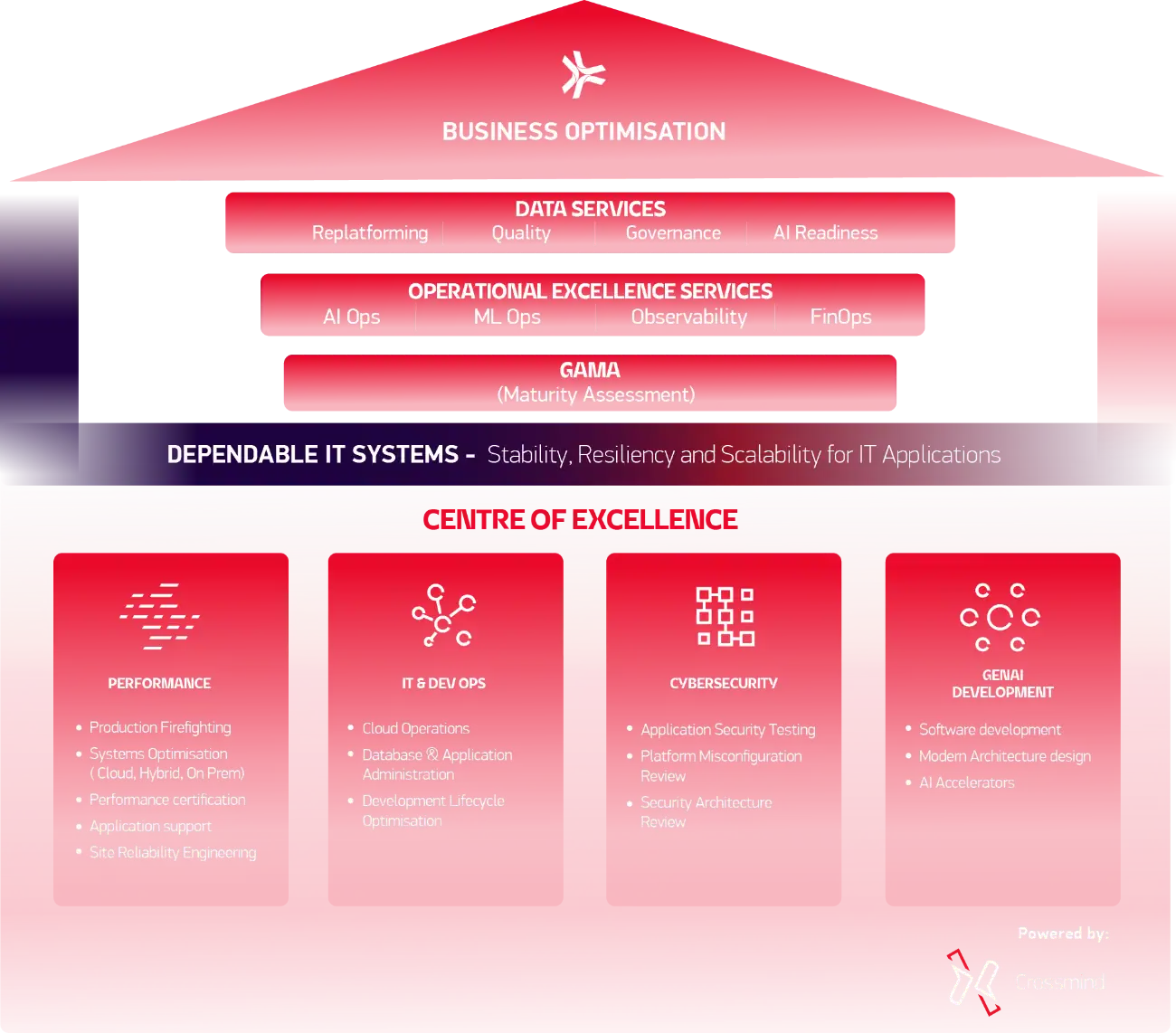
stable, resilient & Scalable
IT SYSTEMS


from the system to the business
with AI
A solid foundation for scaling with AI.
case
Studies
Our work speaks more than what we can do,so why not let it show you what Crossjoincan do for your business.
INTERESTED?



CLIENT
TESTIMONIES

Nineta Tanasoiu at Belgacom/Proximus in 2020
I strongly recommend Crossjoin as a company specialized in performance issues. In our area, they managed to increase the performance of the GLX/JSP flow from more than 24 hours (best time obtained by our off shore delivery team) to only 1,30 hour!!
Nineta Tanasoiu
Manager at Belgacom/Proximus in 2020
Sabine Berckmoes at Telenet
… in IT projects, especially in the field of IS / IT Telco’s with technology and more complex business development and with the need to respond to new monthly challenges. The metaphor of Adam Smith “invisible hand” is represented by Crossjoin and managed by João Modesto and Rodrigo Garcia with their IT skills in Tuning and Performance Systems.
Sabine Berckmoes
Director Network Operations at Telenet
José Ruivo at Amdocs
We have worked together since 2008 in a collaborative team work, that is focused on systems performance and tuning. Since then, we have achieved quite good results.
José Ruivo
Customer Operations Manager at Amdocs
Jandira Peres at Outsystems
We were having sporadic performance issues and we were struggling to understand the cause. In a very short period, Crossjoin identified the root cause and proposed a simple but very effective correction plan. Since then, we trust Crossjoin to help us on complex infrastructure related issues and we are very happy with this partnership.
Jandira Peres
Product Owner at Outsystems
Alexandre Monteiro at Carrot
Unparalleled experience and mastery in RDBMS accompanied by a proactive spirit in problem-solving.
Alexandre Monteiro
Project Manager at Carrot
Punit Bhatia at Vodafone UK
Crossjoin has excelled in the services and the guarantee they offer to Vodafone UK, the CJ staff has been very proactive, as well as the support in any incident. All of his staff have demonstrated excellent technical aptitude and have managed to analyze and solve innumerable problems, both in the performance of the database and in the applications.
Punit Bhatia
Senior Release Manager at Vodafone UK
Cesar Schotborgh at Ericsson Chile
Company with top professionals specialized in performance optimization, providing an high quality service and support whenever it is necessary.
Cesar Schotborgh
Project Manager at Ericsson Chile
Jorge Contreras at Entel
Crossjoin has become a partner of great importance that accompanies us in our day to day always seeking to provide value to the services that we provide the business.
Jorge Contreras
Head of IT Core Platforms at Entel
FAQ's
Latest big news!





Get your
Assessment Today!
Reach out to us for tailored IT solutions
that drive your business forward.


